3 Keys to Better Putting Consistency (And the Putter That Changed My Game)
Tour professionals make roughly 99% of putts inside 3 feet. They drain around 50% from 8 feet. The average recreational golfer? Much lower on both counts. The gap isn’t nerves — it’s mechanics. Putting is the one part of the game where technique, repetition, and the right equipment combine to deliver fast, measurable improvement. Here are the three fundamentals that matter most, plus the putting aid that changed the way thousands of golfers approach the short game.
Why Putting Feels So Inconsistent
Inconsistent putting almost always comes down to one of three things: a face that isn’t square at impact, a path that cuts across the ball, or inconsistent contact point on the putter face. Fix those three things and your putting average will improve immediately.
The challenge is that putting feels so simple that golfers rarely practice it deliberately. They hit a few putts before a round, try to remember to ‘look at the hole,’ and hope for the best. That approach produces inconsistent results. Deliberate practice with a specific focus produces real improvement.
Key 1: Face Angle at Impact Is Everything
Research from putting experts consistently shows that face angle at impact accounts for roughly 80–90% of the starting direction of a putt. If your face is 2 degrees open at impact, the ball starts right of your line — regardless of your stroke path.
The best drill for this: place two alignment sticks or a putter path guide on either side of your putter head, about a half-inch of clearance. Make slow strokes, keeping the putter between the guides. If you hit a guide, your face or path has deviated. This immediate feedback rewires the stroke in minutes.
On the course, do a pre-putt routine that includes a specific focus point: the back edge of the ball, a spot on the green 6 inches in front of the ball, or a mark on your putter face aligned to the center. Consistency of routine creates consistency of face angle.
Key 2: A Consistent Tempo Eliminates Distance Control Problems
Three-putts rarely happen because you missed the line. They happen because you misjudged distance — you left it 8 feet short or blew it 6 feet past. Distance control is 100% about tempo.
The metronome method is the most reliable fix. Set a metronome app on your phone to 72 BPM. Every putting stroke should be: back on the beat, forward on the next beat. The length of your stroke (not the pace) controls distance. Short stroke for short putts, longer stroke for long putts — but always the same tempo.
“Think of your putting stroke like a grandfather clock pendulum: constant rhythm, variable arc length.”
Practice with the metronome once a week for 20 minutes. Within a month, you’ll have internalized a consistent tempo that replaces the anxiety-driven acceleration most golfers use on long putts.
[aawp box=”ASIN_PUTTING_MIRROR”]
Key 3: Eye Position Changes Everything
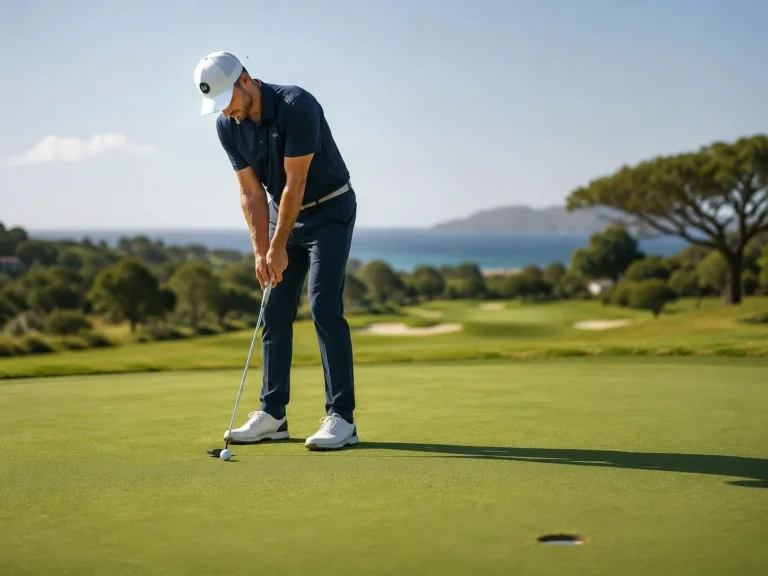
Your dominant eye should be positioned directly over the ball at address — or just inside the ball line. If your eyes are outside the ball, you’ll see the line differently than it actually is and constantly aim left (for right-handed golfers). If your eyes are too far inside, you’ll aim right.
Test your eye position: address a putt, then hold a ball between your thumb and forefinger at nose level, directly below your eyes. Drop it. If your eyes are properly positioned, the dropped ball will land on or just inside your golf ball. If it lands outside, adjust your setup.
This is one of those adjustments that feels wrong at first because your old setup felt ‘natural.’ Give it three rounds before making a judgment. Most golfers find that a single eye position adjustment drops their three-putt average noticeably within two rounds.
The Putter That Changed My Game
Equipment matters in putting, but not for the reasons most golfers think. It’s not about mallet vs. blade, or face inserts, or fancy alignment lines. The biggest equipment factor is lie angle — whether the putter sole sits flat on the ground when you’re at address in your natural stance.
If your putter’s lie angle is off by even 2–3 degrees, the face will aim left or right of your intended line every time. Most off-the-rack putters are built for a standard setup. If you’re shorter, taller, or stand closer to the ball, you may need a putter fit.
A quality putter with the right lie angle for your stance, combined with the three keys above, is a genuine game-changer. Our top recommendations for every budget:
[aawp table=”ASIN_ODYSSEY_11,ASIN_CLEVELAND_HUNTINGTON,ASIN_SCOTTY_CAMERON”]
A Simple 10-Minute Practice Routine
- Gate drill: 5 minutes, 3-foot putts through two tee gates. Make 20 in a row before moving on.
- Clock drill: 4 balls at 3 feet, 4 directions (north/south/east/west). 16 putts, note how many you make.
- Distance control: 3 putts from 20 feet, 3 from 30 feet, 3 from 40 feet. Goal: all within 18 inches.
- One pressure putt: pick a 6-footer that breaks. Must make it before you leave the green.
This routine takes 10 minutes and produces better results than an hour of aimless practice. Do it three times a week and you will be a noticeably better putter within 30 days.
Ready to upgrade your flat stick? Browse our full putter reviews or jump straight to our picks for the best putters for every skill level.