Golf Rangefinder vs GPS Watch — Which One Should You Carry?
Walk into any golf store and you’ll find two types of distance-measuring devices staring back at you: laser rangefinders and GPS watches. Both tell you how far it is to the flag. Both are legal for recreational play. But they work completely differently, and the right choice depends entirely on how you play, how you think, and what you’re willing to spend.
We’ve tested both categories extensively. Here’s the honest breakdown.
How Each Works
Laser Rangefinders
A laser rangefinder fires an invisible laser at a target — typically the flagstick — and measures how long it takes to bounce back. The result is an exact, real-time distance to whatever you’re pointing at. High-end models like the Bushnell Pro XE and Precision Pro NX9 add slope compensation, measuring not just horizontal distance but the adjusted ‘plays like’ distance based on uphill or downhill angle.
GPS Watches
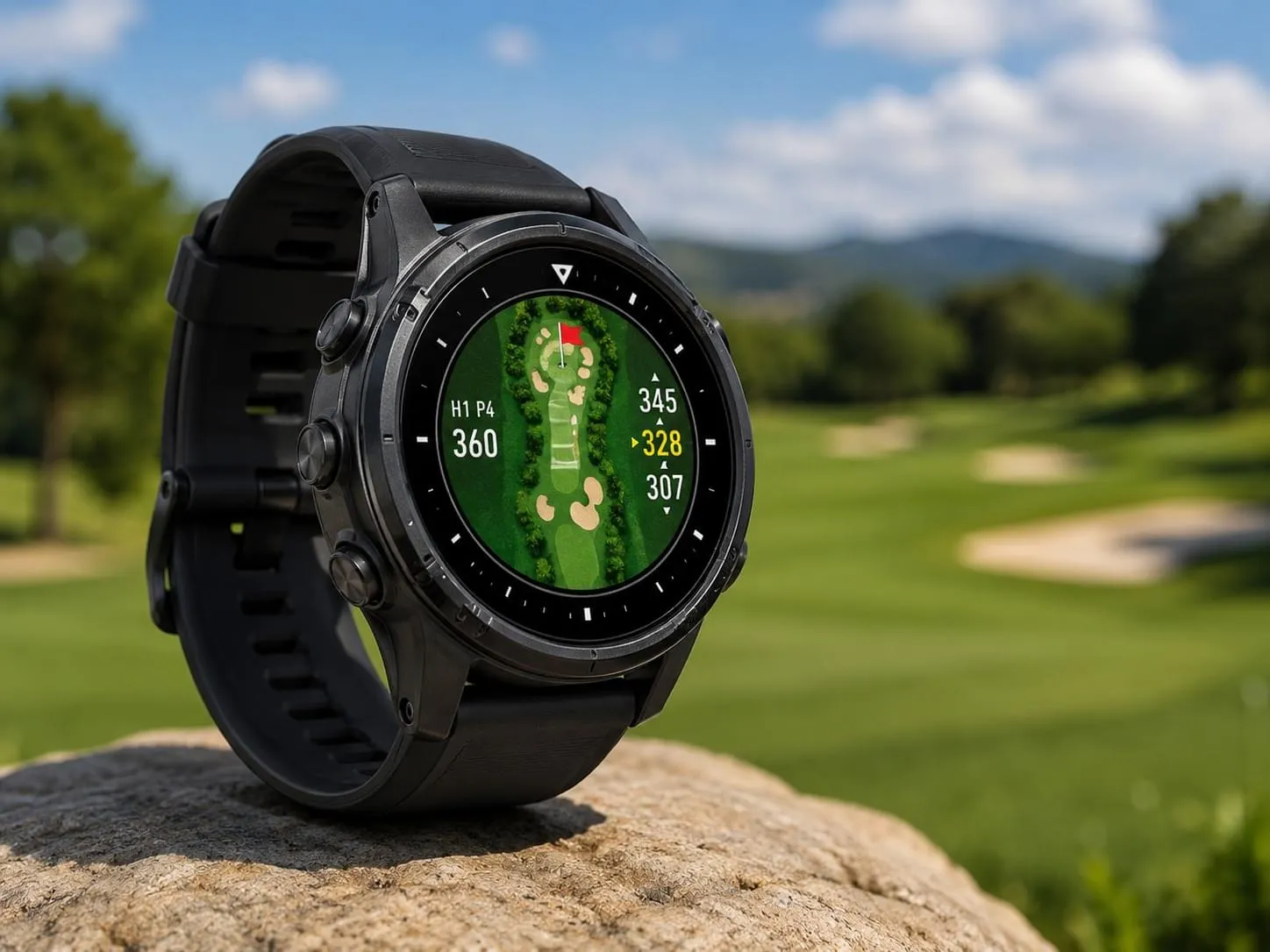
GPS watches use satellite data and preloaded course maps to show you distances to the front, middle, and back of the green, plus hazards and layup distances. They don’t require you to aim at anything — you glance at your wrist and the numbers are there. Higher-end models like the Garmin Approach S62 add features like a virtual caddie, full-color course maps, and shot tracking.
Accuracy Comparison
Laser rangefinders win on pure accuracy. A quality rangefinder is accurate to within one yard and updates in real time. GPS watches are typically accurate to within 2–3 yards, and that accuracy depends on how recently the course maps were updated and how strong your satellite connection is.
For most golfers, the difference between 154 yards and 156 yards doesn’t affect club selection. But for better players who are precise with their distances, the rangefinder’s accuracy matters.
Speed of Use
GPS watches win on convenience. A glance at your wrist gives you the distance instantly, mid-stride, without stopping. Rangefinders require you to stop, raise the device, find the flag, lock the laser, and read the display. On a busy course, that takes 15–30 seconds per shot.
Over 18 holes, the GPS watch saves you time. Over a single crucial shot on the back nine, the rangefinder gives you more confidence in the exact number.
Hazard and Layup Information
GPS watches have a significant advantage here. While a rangefinder can technically target a hazard marker, it requires you to know which marker to aim at. A GPS watch automatically shows distances to all hazards on the current hole — often displayed visually on a course map.
For course management and strategic play, the GPS watch is far more useful. You can see at a glance that there’s water at 210 yards and a safe layup area at 185 — and plan your shot accordingly before you even reach the ball.
[aawp table=”ASIN_BUSHNELL_PRO_XE,ASIN_GARMIN_S62″]
Price Comparison
- Entry-level rangefinders: $80–$150 (basic yardage, no slope)
- Mid-range rangefinders: $150–$300 (slope compensation, faster lock)
- Premium rangefinders: $300–$500 (magnetic mount, tournament-legal slope toggle)
- Entry-level GPS watches: $100–$200 (basic yardages, limited features)
- Mid-range GPS watches: $200–$350 (full course maps, hazard distances)
- Premium GPS watches: $350–$600 (virtual caddie, performance tracking, smartwatch features)
Which Should You Buy?
Choose a laser rangefinder if you:
- Are a 10-handicap or better and rely on precise yardages
- Play a variety of courses and need accurate pin distances
- Prefer exact numbers over approximate estimates
- Already have a regular watch you like
Choose a GPS watch if you:
- Play most of your golf on 2–3 familiar courses
- Value convenience and want both hands free
- Use course management as part of your strategy
- Want hazard distances without extra effort
- Like tracking your game stats over time
The honest answer for most golfers: buy a mid-range GPS watch first. The convenience, hazard data, and stat tracking deliver more value across a full round than pin-point accuracy on a single shot. If you later find yourself needing exact pin distances, add a budget rangefinder as a second tool.
See our full review of the Garmin Approach S62 and the Bushnell Pro XE Rangefinder for detailed breakdowns of each.